CMX865A
– DTMF Codec/FSK Combo
CMX865A
– DTMF Codec/FSK Combo
The CMX865A is a DTMF Codec/FSK Combo multi-standard modem for use in Wireless Local Loop, including Fixed Wireless Terminals and Fixed Wireless Phone installations and Short Message Service telephone systems.
Flexible line driver, hybrid and receiver circuits are integrated on chip, requiring only passive external components to build a 2 or 4-wire line interface.
POTS Signalling
A high-quality DTMF decoder with excellent immunity to falsing-on-voice, and a standard DTMF encoder are included. Alternatively, these blocks can be used to transmit and detect user-specific: programmed single and dual-tone signals, simple melodies, call progress signals or modem calling and answering tones.
Devices are available through our Distributor Network.
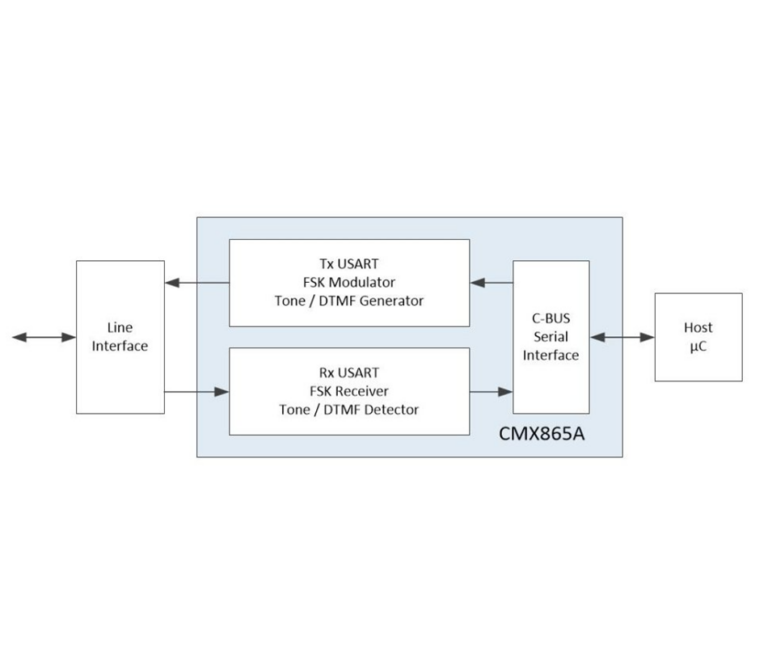
Features of the CMX865A – DTMF Codec/FSK Combo include:
- V.23 1200/75, 1200/1200, 75, 1200 bps FSK
- Bell 202 1200/150, 1200/1200, 150, 1200 bps FSK
- V.21 or Bell 103 300/300 bps FSK
- Low Voice Falsing DTMF Decoder
- DTMF/Tones Transmit and Receive
- Low Power – High Performance
- ‘Powersave’ Standby Mode
- Can achieve simple voice record and playback actions
Applications the CMX865A – DTMF Codec/FSK Combo can be used for:
- Wireless Local Loop
- Fixed Wireless Terminals (FCT/FWT)
- SMS Phones
- Security Systems
- Remote Utility Meter Reading
- Industrial Control Systems
- Pay-Phones
- Set-Top Boxes
Power Supply Requirements for the CMX865A – DTMF Codec/FSK Combo:
- 3.0 to 3.6 V power supply
CMX865 and CMX865A FAQ
CMX86x and CMX850 Filter Coefficient Generator Program
This application note comprises the Filter Coefficient Generator program as an Excel spreadsheet as well as operational instructions.
CMX8xx: Short Message Service (SMS) Implementation using CML Products
This document aims to assist modem product designers using and understanding Short Message Service (SMS) applications. CML Microcircuits’ (CML) integrated circuit devices (CMX85x and CMX86x) could be used to realize and achieve a Caller Line Identification (CLI), SMS or Low Rate Messaging Service (LRMS) data transfer within a wireline system.
CLI with the CMX860, CMX865/A, CMX867/A and CMX868/A
Caller Line ID (CLI) was originally developed for the US market but has become commonplace throughout the World because of its multitudinous applications. There are a number of CLI protocols to which telephone equipment manufacturers must comply. This document gives an overview of two types; BELL GR-30-CORE/SR-TSV-002476 (or ETSI 300 659-1 section 6.1.1) used in the USA and most of the world and Caller Line Identification Presentation (CLIP) BT SIN 227 (or ETSI ETS 300 659-1 section 6.1.2c) used in the UK.
Recommendations for V.23 1200/75 b/s duplex call set-up
V.23 recommendations do not describe how a connection is established; a procedure is described below and illustrated in Figure 1; however you should not rely on other modems following this particular flow. Note also that 1200/1200 bps half-duplex connections are not covered by this application note.
CMX865A: Addressing SIA Protocols with the CMX865A
Security alarm panels are used around the world as a cost-effective means of protecting people and property. The Security Industry Association (SIA)1, a trade organization that represents security market companies, has developed protocols that describe the communications link used by these panels. DTMF tones, pulsed tones, and frequency-shift keying (FSK) are common signaling methods used throughout these SIA protocols. The CMX865A low-power wireline modem can be easily configured to perform these SIA protocols making it attractive for security panel applications. The purpose of this document is to describe how the CMX865A can be made to perform SIA communication protocols.
CMX865A: Motorola MC145443 to CMX865A Migration
CMX865A: Motorola MC145443 to CMX865A Migration
CMX865A Employed in Short Local Loops (SLL)
CMX865A Employed in Short Local Loops (SLL)
CMX865A – Tx V.23 FSK
Transmits FSK including a preamble. There is additional code for dialling and call progress. Works with the Rx FSK.pes file.
CMX865A – Rx V.23 FSK
A script that receives FSK including the preamble detection. There is additional code for the support of call progress. Works with the Tx FSK.pes file.
CMX865A – Reset to Operating
A simple script to reset the device and put it into operating mode.
CMX865A – Reset to Powersave
A simple script to reset the device and put it into powersave mode.
CMX865A – Programmable Tone Generators
Sets up the Programmable Tone Generators (PTG) to generate custom tones or simple melodies. A spreadsheet to calculate the required values, can be downloaded from the Knowledge Base Tab.
CMX865A – DTMF Decode
To Set the CMX865A into DTMF decode mode.
CMX865A – Ademco Contact ID
Audacity Project files for Ademco emulation.
CMX865A – Programmable Tone Decode
To set up the CMX865A Programmable Tone Detectors (PTD) for decoding the Ademco handshake and kissoff tones.
CMX865A – VoiceRecordandPlayback
Voice record and playback files using the CMX865A. Please refer to the Applications section of the datasheet.
CMX865A – Line State Detect
Uses the ADC in test mode to read the DC voltage across the line (snoop resistors required) to determine: “Line connected”/”not-connected” or “Line-in-use”. Also contains a sub to reset the core to allow the method to be used with general modem function.
CMX86x: Tone Generator Calculator spreadsheet.
An Excel spreadsheet that calculates the values required for the Programmable Tone Generators. Single tones and dual-tones are allowed. The spreadsheet predicts the actual frequency and amplitude of each tone.
C-BUS Guides
Guides to operation and interfacing

Quick Product Selector

Looking for extra information?
Get in touch with your questions and one of the team will get in touch shortly.


Looking for one of our distributors?
Find your local distributor here
Get in touch
"*" indicates required fields