CMX838
– FRS/GMRS/PMR446 ‘Family Radio’ (signalling and voice) Processor
CMX838
– FRS/GMRS/PMR446 ‘Family Radio’ (signalling and voice) Processor
The highly integrated CMX838 Family Radio Processor includes subaudio, audio, and synthesiser functions to serve as the core engine for low cost, high performance FRS, GMRS and PMR446 radio designs.
Its flexibility supports both simple and advanced multi-channel radios without cost penalties. Integrated Tx voltage reference and baseband clock generation circuits eliminate the need for external components.
The CMX838’s features directly support advanced end-product functions such as: group calling, scanning, automatic scanner response tone setup, and Tone Cloning™.
The use of the CMX838 in one global radio design can support multiple standards and markets.
Controlled via a serial interface (C-BUS) this Family Radio Processor IC operates from a 3V to 5V supply and is available in 28-pin TSSOP and SOIC packages.
Devices are available through our Distributor Network.
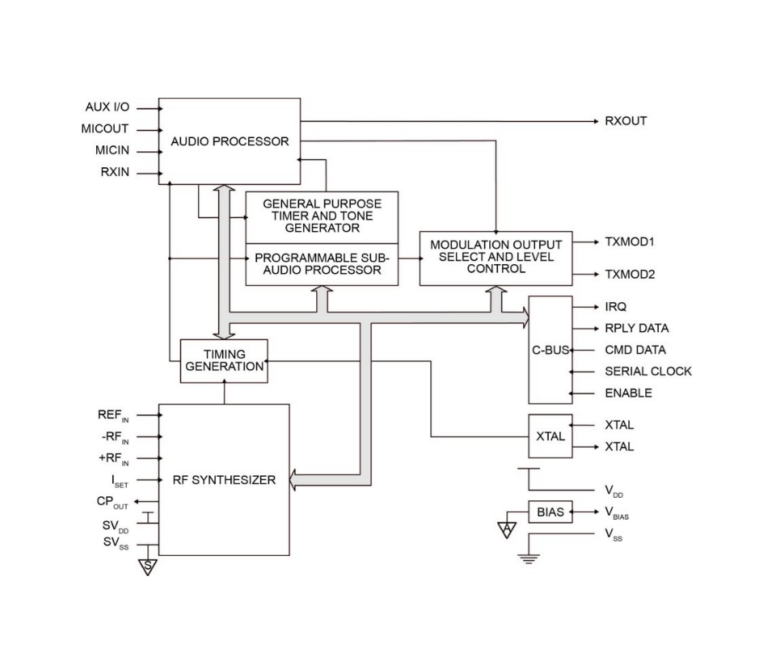
Features of the CMX838 – FRS/GMRS/PMR446 ‘Family Radio’ (signalling and voice) Processor include:
- Advanced ‘Any-One-of-Any’ CTCSS Sub-Audio 50-Tone Processor
- Fast Decode Time
- IRQ on Any/All Valid Tones
- Fast Scan, Group Calling, Auto Response Tone Select and Tone Cloning Support
- Supply Independent Output Level
- RF Synthesiser for FRS, PMR446, MURS and GMRS RF Channels
- Configurable Charge-Pump
- Audio Call Tone Generator
- Audio Processing Provides:
– Mic Amplifiers, Limiter
– Pre and De-Emphasis
– Post Limiter Filtering
– Mic Rx and Tx Digital Gain Controls
– Dual Tx Outputs - Serial Control Interface
- Signal Source and ‘External’ Functions
Applications the CMX838 – FRS/GMRS/PMR446 ‘Family Radio’ (signalling and voice) Processor can be used for:
- Family Radio Service (FRS)
- Pan-European PMR 446; Hand Portable Mobile Radio
- General Mobile Radio Service (GMRS)
Power Supply Requirements for the CMX838 – FRS/GMRS/PMR446 ‘Family Radio’ (signalling and voice) Processor:
- 2.7V
CMX838 and 10kHz Channel Spacing FAQ
Q. I am interested in obtaining 10kHz channel spacing with the CMX838, but I see that 10kHz is not a supported channel spacing. Is there any way that I can achieve this channel spacing?
A. It is possible, but many considerations will need to be made to ensure everything works as desired. At a top level, the plan involves:
– program the CMX838 for 20kHz channel spacing.
– program the CMX838 to use a particular reference oscillator value (e.g. 24MHz).
– actually use a reference oscillator of one-half the programmed value (e.g. 12MHz).
– this would result in 10kHz spacing instead of 20kHz spacing.
– use a recommended crystal for the baseband clock.
The key to making this approach work is to use a reference oscillator whose value, when doubled, is also on the list of supported reference oscillators (i.e. Section 5.1.2.7 of CMX838 data sheet, bits 5-2). This will allow for programming one supported frequency while using another.
The fact that the “real” oscillator is half of what the CMX838 thinks it is should cause the real channel spacing to be half of what the CMX838 thinks it is, namely, 10kHz.
NOTE: if a particular RF channel center frequency is programmed into $8B (“Synthesizer Channel Select” register), and if the actual RF reference oscillator is half of its programmed value, the RF channel center frequency produced by the CMX838 will be half of the programmed value. Consequently, this approach will require generic RF channel programming per Section 5.1.2.11 of the CMX838 data sheet.
Another caveat with this approach is the baseband clock generation:
– if the CMX838 is generating the baseband clock from the RF reference oscillator…
– and if the CMX838 is programmed for a RF reference oscillator of 20.95MHz…
– but the CMX838 is actually supplied with a RF reference oscillator of 10.475MHz…
…all of the CTCSS tones will be half of their programmed value, and the internal SCF clocks will be half of their intended value too.
Therefore, if this approach is used to obtain 10kHz channel spacing, a dedicated baseband clock signal (from the list of supported frequencies in the data sheet) must be used for the baseband clock generation.
Quick Product Selector
Looking for extra information?
Get in touch with your questions and one of the team will get in touch shortly.


Looking for one of our distributors?
Find your local distributor here
Get in touch
"*" indicates required fields