CMX823
– Programmable Paging-Tone Decoder
CMX823
– Programmable Paging-Tone Decoder
The CMX823 is a high performance, low power, audio tone decoder that can operate on low S/N signals.
Each decoded tone frequency is user-defined to provide the flexibility to operate in a variety of paging, two-way radio and proprietary systems.
Example systems and tones include: Motorola Quick Call series; GE groups A, B and Zetron, Reach and Plectron 2-tone radio paging; Motorola 5/6-tone paging; and the EIA, CCIR, ZVEI1 and EEA tonesets used for HSC radio paging and selcall.
Up to 32 user-defined decode tone frequencies from 280Hz to 3500Hz are written to an internal RAM-based FIFO. (Two separate 32-tone FIFOs are provided and support fast switching between tone sets).
Each programmed tone (entry in the list) is user-assigned to one of two (or both) tone groups. Two-tone sequence decoding is simplified by dynamically enabling one or the other tone group via a mode selection.
The CMX823 asserts an interrupt on tone decoding state transitions, e.g. notone to decoded tone, decoded tone to notone, etc. STATUS and DECODED TONE PARAMETERS Registers may then be read and indicate the decoder status, the target tone decoded and its tone group.
Devices are available through our Distributor Network.
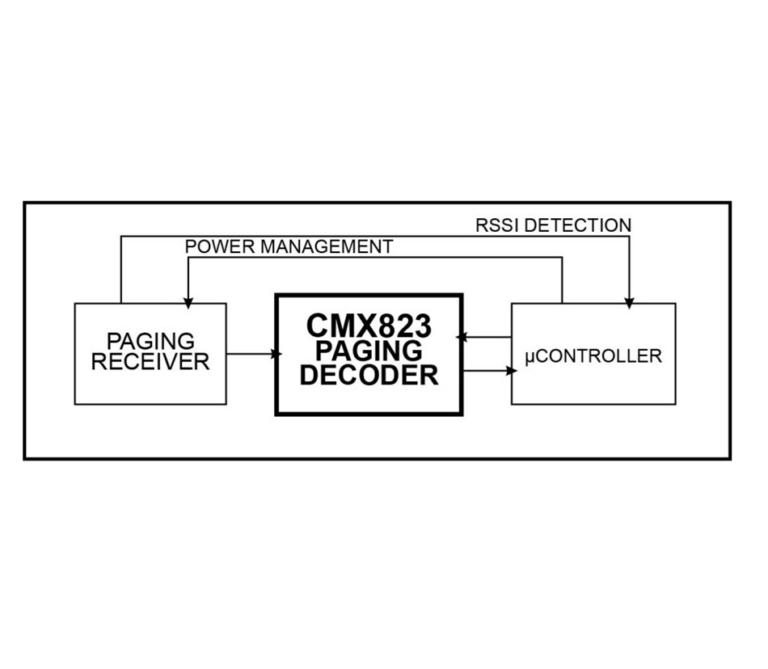
Features of the CMX823 – Programmable Paging-Tone Decoder include:
- Decodes 32 User-Programmed Tones
- Stores Two Lists of 32 Tones to Fast-Switch Between Tone Sets
- Configurable Decode Response-Time and Decode Bandwidths
- Low Power: 0.75mA at 2.7V and ‘Zero-Power’ Powersave Mode
- Superior Signal-to-Noise Performance
- Low-Cost 3.58MHz Xtal/Clock
Applications the CMX823 – Programmable Paging-Tone Decoder can be used for:
- Two-Tone, 5/6 Tone and Voice Pagers
- Selective Calling (Selcall) Systems
- Wireless Local Loop Signalling
- Voice Pager Switching and Signalling
- Revertive Paging Systems
- Audio Tone Signalling Applications
Power Supply Requirements for the CMX823 – Programmable Paging-Tone Decoder:
- 2.7 V
CMX823 FAQ
Q. I am considering migrating from the CMX813 to the CMX823, to take advantage of it programmable tone table, can you help me understand the differences between these two devices
A. The CMX823 should be considered to be an enhanced CMX813, in that it is pin, package and virtually function compatible. The CMX823 takes the excellent CMX813 and adds full tone programmability so that user tone sets are now possible, enhanced S/N tone detection performance and improved tone resolution and accuracy. In terms of hardware it is a plug and play solution.
In Software there are two additional registers to be made aware of and some differences in existing Registers, the following table identifies which registers differ. For more detail on the register specifics please refer to the respective data sheets.
Quick Product Selector
Looking for extra information?
Get in touch with your questions and one of the team will get in touch shortly.


Looking for one of our distributors?
Find your local distributor here
Get in touch
"*" indicates required fields