CMX869B
– Low Power V.32 bis Modem
CMX869B
– Low Power V.32 bis Modem
The CMX869B is a multi-standard low power modem for use in EPOS terminals and telephone based information and telemetry systems. This highly integrated single-chip modem IC provides the functions needed to implement a ITU V.32 bis automode modem or a V.22 bis, V.22, V.21 and Bell 202, Bell 103 compatible modem operating under the control of external host timing for EPOS and other proprietary protocols.
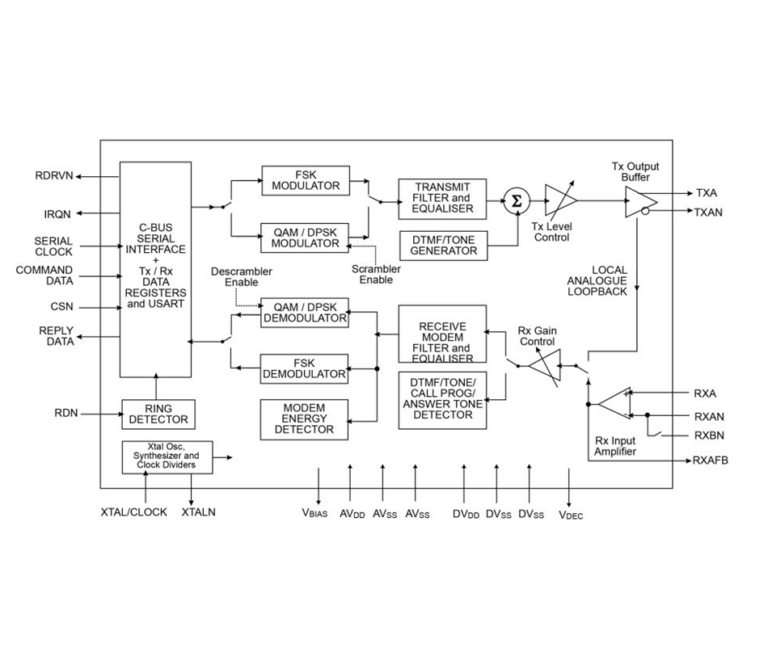
The device integrates a V.32 bis automode modem, DTMF decoder, software-controlled output, ring detector, and line inputs and outputs that can be single ended or differential. Host control and data transfer is via CML’s C-BUS high-speed serial bus.
Devices are available through our Distributor Network.
Features of the CMX869B – Low Power V.32 bis Modem include:
- V.32 bis/ V.32/ V.22 bis/ V.22 Automodem
– (14400, 12000, 9600, 7200, 4800, 2400, 1200 bps Duplex) - V.22 bis/V.22 Manual Modem
– (2400, 1200 bps) - V.23 (1200/75, 1200/1200, 75, 1200 bps FSK)
- Bell 202 (1200/150, 1200/1200, 150, 1200 bps FSK)
- V.21 or Bell 103 (300/300 bps FSK)
- High Performance DTMF Modem
- Single/Dual Tones Transmit and Receive
- ‘Powersave’ Standby Mode
- Asynchronous, Synchronous and HDLC Modes
Applications the CMX869B – Low Power V.32 bis Modem can be used for:
- EPOS Terminals
- Telephone Telemetry Systems
- Remote Utility Meter Reading
- Security Systems
- Industrial Control Systems
- Electronic Cash Terminals
- Pay-Phones
- Cable TV Set-Top Boxes
Power Supply Requirements for the CMX869B – Low Power V.32 bis Modem:
- 3.0 to 3.6 V
CMX869B FAQ
Q. Can you help me understand the differences and migrate between the CMX869x families of devices?.
A. There are a number of minor differences between devices, to help explain these differences and make the most of the CMX869x please refer to the following application note: AN_Telecom_869B_Upgrade_1_August_06.pdf.
CMX869B DAA Circuit with Line State Detection
The circuitry used to connect a modem to a telephone line, also referred to as a “direct access arrangement” or DAA, can represent a significant hurdle for some customers. To assist these customers, this application note describes one method of connecting the CMX869B to the telephone network using low-cost components. In addition to the basic DAA function, other circuitry is provided for the CID and 911 detection functions.
CMX868A, CMX869B Modems with CLARE Litelink DAA
This application note describes how the Clare CPC5621 optical DAA can be used to interface the CMX868A V.22bis and CMX869B V.32bis modem chips to the telephone line. The primary benefit of the Clare LightLink DAA is that it requires very little board area and has a very low profile. This can be important in applications where there are tight space constraints.
CMX86x and CMX850 Filter Coefficient Generator Program
This application note comprises the Filter Coefficient Generator program as an Excel spreadsheet as well as operational instructions.
CMX869x Modem Series Upgrade Path
The CMX869x modem series provides the functions necessary to implement a V.32 bis automode modem and includes all of the signaling likely to be required within the General Switched Telephone Network, GSTN or PSTN. Some applications normally use a low data rate for regular traffic but require a much higher data rate for occasional traffic. To support such applications the original CMX869 specification has been extended through the CMX869A and CMX869B. There are no pin-out or signal differences between the CMX869x devices so they may be used interchangeably in the same hardware. However, extending the function set required minor register bit re-assignments that affect firmware portability. The aim of this document is to illustrate these changes and to detail the migration of code between devices in the series.
CMX869B – Bell 212A Implementation
The CMX869B V.32bis modem IC from CML Microcircuits offers multiple modem protocol support in both automodem and manual modes, a rich telephony feature set, and low power consumption. The purpose of this document is to describe how Bell 212A can be supported using the V.22 mode of the CMX869B modem IC.
CMX869x Caller Line ID
CLI operates in two distinctly different modes, on-hook and off-hook, which are often referred to as type 1 and type 2 respectively. The on-hook mode is the most widely used because the CLI is delivered before the call is accepted. Here the calling parties identity may be used within the system in a decision making process. For example, a simple call filter that rejects calls from callers who withhold their own number. Off-hook systems find more limited use because the target function is to let the called party know the identity of a missed caller. This document covers only on-Hook or type 1 CLI although the principles may be extended for some type 2 services.
CMX8xx: Short Message Service (SMS) Implementation using CML Products
This document aims to assist modem product designers using and understanding Short Message Service (SMS) applications. CML Microcircuits’ (CML) integrated circuit devices (CMX85x and CMX86x) could be used to realize and achieve a Caller Line Identification (CLI), SMS or Low Rate Messaging Service (LRMS) data transfer within a wireline system.
Recommendations for V.23 1200/75 b/s duplex call set-up
V.23 recommendations do not describe how a connection is established; a procedure is described below and illustrated in Figure 1; however you should not rely on other modems following this particular flow. Note also that 1200/1200 bps half-duplex connections are not covered by this application note.
CMX867 – V.22 Full Duplex Call Set Up
This document provides details on the V.22 wire-line communications
View
V.22bis Full Duplex Call
This document provides details on the V.22bis wire-line communications protocol
View
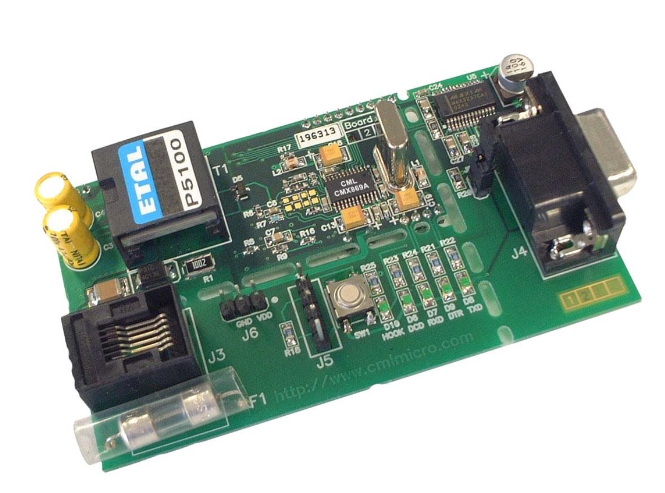
| DE8691 | The DE8691 Demonstration Board features the CMX869B V.32 bis modem IC in a “socket modem format” implementation. The “socket modem” section also contains the line interface components and a Flash PIC µC.
|
DE8691_Product_Preview
|
CMX86x: Tone Generator Calculator spreadsheet.
An Excel spreadsheet that calculates the values required for the Programmable Tone Generators. Single tones and dual-tones are allowed. The spreadsheet predicts the actual frequency and amplitude of each tone.
C-BUS Guides
Guides to operation and interfacing
DE8691 Board Schematics
DE8691 Support Files
Support Files for the DE8691 Demonstration Kit

Quick Product Selector
Looking for extra information?
Get in touch with your questions and one of the team will get in touch shortly.


Looking for one of our distributors?
Find your local distributor here
Get in touch
"*" indicates required fields