CMX649
– Adaptive Delta Modulation (ADM) Voice Codec
CMX649
– Adaptive Delta Modulation (ADM) Voice Codec
Product description
The CMX649 Adaptive Delta Modulation (ADM) Voice Codec provides full duplex codec functions optimised for cost effective, portable, wireless applications.
Standard and lower cost digital voice applications are supported via selectable operating modes.
Robust ADM coding simplifies protocol and host software design by eliminating the forward error correction and framing protocols required by other codec algorithms.
Multiple codec sample/data rates and codec sample clock sources are supported. Integrated filters reduce external components and adjust to match the selected codec sample rate.
Independent encoder and decoder powersave controls minimise power for half duplex wireless links.
Devices are available through our Distributor Network.
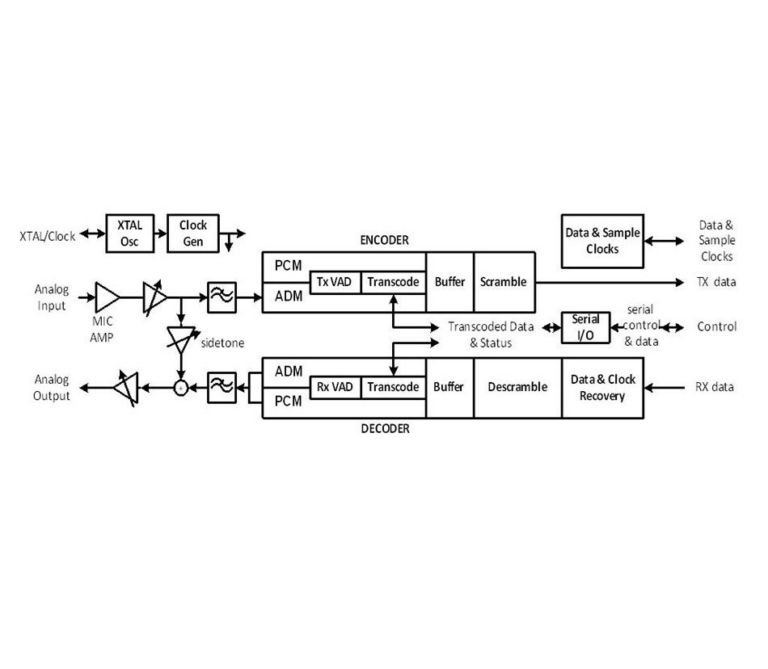
Features of the CMX649 – Adaptive Delta Modulation (ADM) Voice Codec include:
- CVSD for Digital Voice Communication
- Adaptive Delta Modulation (ADM)
- Non Linear PCM: µ-Law and A-Law Modes
- 13-Bit Linear PCM Codec
- Programmable Analogue Inputs and Outputs, Time Constants for ADM Codec and Anti-Alias and Anti-Image filters
- Clock and Data Recovery
- Wide Data-Rate Range: 16 to 128 kb/s
- Programmable Voice Activity Detector (VAD)
- Transcoding, internal/external sample clocking and flexible uC interfaces
Applications the CMX649 – Adaptive Delta Modulation (ADM) Voice Codec can be used for:
- Digital Cordless Headsets and Telephones
- Personal Area Network (PAN) Voice Links
- Wireless Digital PBX
- Full-Duplex Digital Radio Systems
- Time-Division Duplex (TDD) Systems
- Portable Digital Voice Communicators
- Voice Storage and Voice Delay
Power Supply Requirements for the CMX649 – Adaptive Delta Modulation (ADM) Voice Codec:
- 2.7 to 5.5 V
CMX649 Sound Samples
The CMX649 ADM Voice Codec IC provides full-duplex ADM, companded and linear PCM and transcoder functions for digital wireless communications.
This demonstration provides a comparative ADM audio presentation of a range of CMX649 end-to-end (encode/decode) audio outputs using sampling rates of 16kb/s, 24kb/s, 32kb/s, 64kb/s and 128kb/s.
Use the links below to compare; for this demonstration you will need a good-quality sound system on your PC; with the volume set at a comfortable level.
Audio Output at 16kb/s
Audio Output at 24kb/s
Audio Output at 32kb/s
Audio Output at 64kb/s
Audio Output at 128kb/s
CMX649 and DE6491 FAQ
Q. Whilst using the DE6491 Demo Kit, audio output quality sometimes deteriorates. Is there any advice that can be offered to alleviate this phenomenon?
A: The most common reason for an increase in noise and reduction in voice quality is the state of the onboard batteries.
The kits are designed to function with a 2.9 – 5.5 V power supply or with two alkaline AAA batteries. It is clear that whatever batteries are chosen, their voltage will drop over time and fall below the 2.9V minimum level; this will effect overall Bit Error Rate and consequently output voice quality and noise floor.
CMX649 Recommended Settings
CMX649 Recommended Settings Application Note
CMX649 Operation and Application
CMX649 Operation and Application
CMX649 Wireless Voice Link Design Guide
Reference design for a compact full-duplex, wireless voice link using the CMX649. RF operation is in the ISM band
Download
Quick Product Selector
Looking for extra information?
Get in touch with your questions and one of the team will get in touch shortly.


Looking for one of our distributors?
Find your local distributor here
Get in touch
"*" indicates required fields